 STRUXA
A finger splint is small, but its design territory is crowded. It meets skin, bends through space with the hand, approaches neighboring fingers, and passes near everything the wearer touches. It must also be cleaned, stored, understood, and accepted as part of an everyday routine.
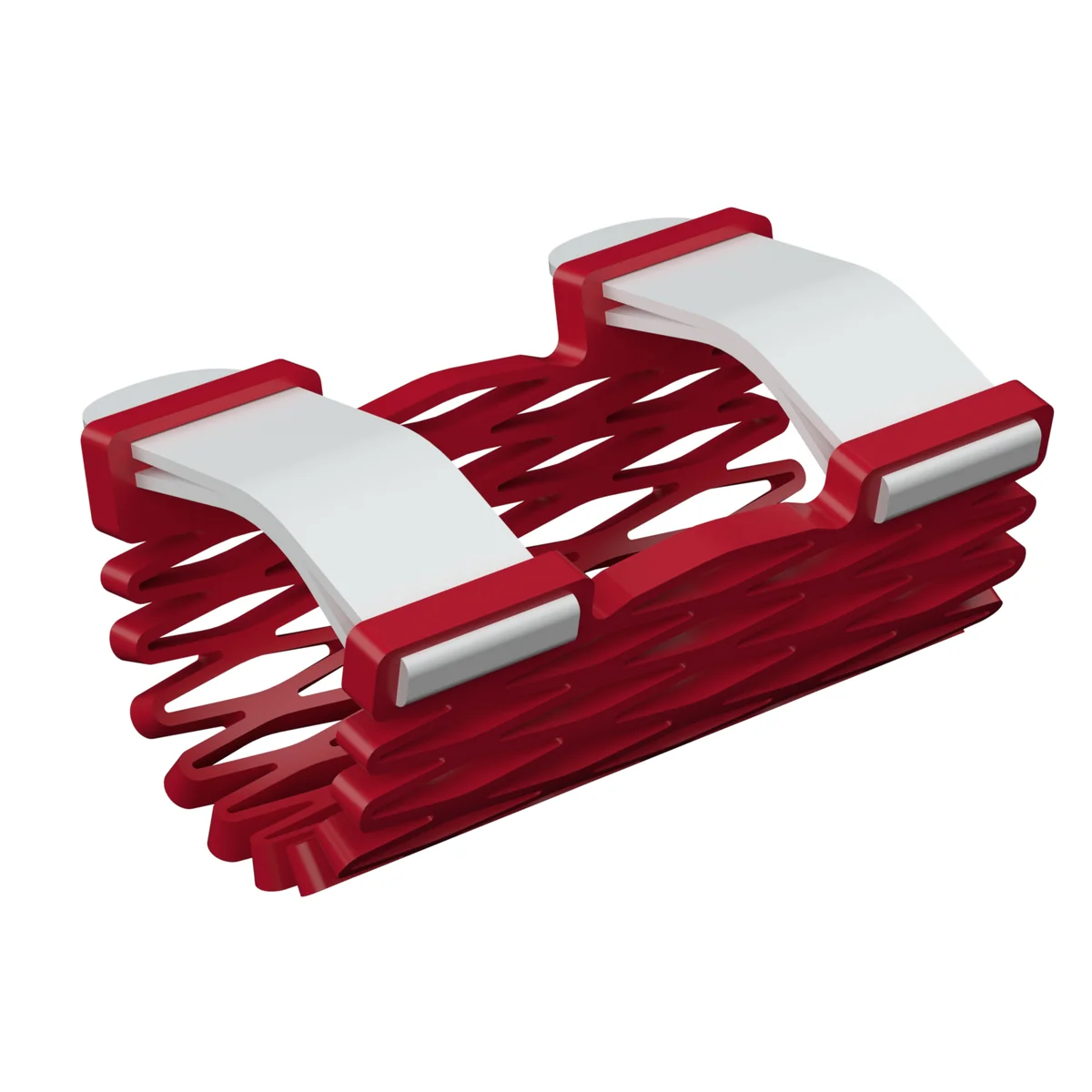
Struxaform™ Technology addresses that territory through an engineered open lattice. The structure places material where support matters, remains open for airflow, and is additively manufactured as one continuous form. Those are engineering decisions. They are also industrial-design decisions because they shape the relationship between product, person, and environment.
The product sits between two moving systems
One system is the hand. The other is the world around it.
The hand changes shape as it types, grips, points, reaches, and rests. The surrounding world presents tight clearances: a sleeve cuff, a pocket opening, the gap between keys, the handle of a cup, the edge of a notebook.
A low-profile finger splint must negotiate both systems without adding more volume than its purpose requires. This is why profile is not merely a side-view measurement. It is the product’s physical relationship to everything nearby.
Consider pulling a hand from a jacket pocket. A large protrusion may catch even if the splint feels acceptable while the hand is still. A close form reduces that unnecessary interaction. The design earns its restraint during the transition, not in a studio photograph.
Restraint makes the function legible
Struxa’s visual language is minimal because the structure already has something to say. The lattice shows where material is present and where space has been preserved. Adding decorative bulk would obscure that logic.
This kind of restraint is not about making a support product look like jewelry or pretending it is not there. It is about allowing the useful form to remain the dominant form. The connected geometry, open areas, and close profile become the appearance because they are also the working decisions.
“Nothing decorative, nothing extra” is how Struxa describes its approach to structure. In industrial design, that does not mean nothing was considered. It usually means more decisions have been resolved before the product reaches the eye.
Touch is more than softness
Softness can contribute to contact comfort, but touch also includes edge location, surface openness, heat, pressure, and how the product moves beside the body.
The standard Struxaform™ Finger Splint uses a non-cushioned configuration. The Struxaform™ Full-Finger Splint adds an integrated cushioned backing where the product meets the finger. Both retain the open-lattice platform.
This makes cushioning a deliberate configuration rather than a blanket answer to comfort. The rest of the industrial-design system (weight, airflow, fit, and profile) still matters. A soft element cannot compensate for every other interaction, just as a rigid element is not automatically uncomfortable by definition.
Care belongs in the form brief
A product worn against the hand must be maintained. Struxa splints are washable by hand with mild soap and cool-to-lukewarm water, then air dried completely. The open architecture makes the structure visible during that routine.
Heat is a design boundary. Hot water, dishwashers, washing machines, radiators, hair dryers, and hot cars can affect the printed material. Good industrial design includes communicating those limits clearly rather than treating care as an afterthought.
The routine also shapes storage. A splint needs a clean place to dry away from direct heat, not a complicated maintenance system. Simplicity here is part of everyday usability.
Manufacturing and form should speak the same language
Struxa’s open lattice is made through additive manufacturing from a digital model. The process builds the splint layer by layer as a continuous structure.
That alignment between method and form matters. The product does not look additively manufactured because a texture was added for effect. Its geometry depends on a process capable of producing connected, open paths as designed. Manufacturing becomes visible in the logic of the object.
Because design, engineering, prototyping, and production are kept in Colorado under one roof, the physical product remains close to the disciplines defining that logic. The result is not simply local provenance. It is a coherent chain from design intent to manufactured form.
Quiet design is active design
A low-profile splint may aim to attract less attention in use, but achieving that quietness requires active decisions. The form must be selective about material, deliberate about contact, clear about care, and compatible with a hand that keeps entering new spaces.
This is what makes a finger splint an industrial-design problem. It is never only an object around a finger. It is an interface between a person and a day.